Flusser Studies 41 – May 2026 / Special Issue: Vilém Flusser and Artificial Intelligence
‘La caméra photographique est une intelligence artificielle’ Occurrence of the Notion of ‘Artificial Intelligence’ in Vilém Flusser’s writings
This essay is simply a compilation of the occurrences of the words “artificial intelligence” in all languages in Flusser’s writings. For lack of access to a global database, it is not exhaustive. It includes all occurrences in the French languages, and occurrences in other Flusser’s works that could be analyzed online in Portuguese, English and German. Flusser has used these words between 1982 and his death, in a variety of contexts, and with different meanings. Clearly, they have little to do with the meaning of AI today. While it is difficult to define a pattern of use of these words in his work, some of the quotations are noteworthy.
A New Way of Reading Called Computing (from “Does Writing Have a Future?”
In this short excerpt from “Does Writing have a Future” Flusser narrates a familiar historical-technical moment, the moment when the tradition of thinking based on linear causal arguments becomes supplanted by a mosaic form of synthetic thinking through the assembly of bits. After the world is exposed by rational science to be meaningless and all belief is rendered absurd, computation, (the synthesis of meaning through bits) is invented to re-establish meaning in the gesture of reassembling meaning itself and thereby belief. In other words, where the truth of existence is exposed by science, making criticism obsolete, criticism returns in the subjective reassembly of bits into meaning. Once again on the brink of the abyss, Flusser offers his readers an apocalyptic panacea in a renewed commitment to subjectivity.
Part I: Playing Against the Apparatus
Hallucinations techno-imaginaires : une critique flussérienne des systèmes d'IA générative / Tecnoimaginando alucinações : uma critica flusseriana aos sistemas de IA generativa
The article examines so-called hallucinations in generative artificial intelligence models through the lens of Vilém Flusser’s philosophy of technology, interpreting them not merely as technical failures but as revealing symptoms of the structure and normativity of these systems. Drawing on Flusser’s notion of the apparatus as a black box, the article establishes a parallel between the photographic apparatus and AI models, whose internal functioning remains opaque to both users and developers. The text critiques the anthropomorphic use of the term “hallucination,” arguing that it euphemizes systemic errors and obscures their epistemological presuppositions. In contrast, hallucinations are understood as productive failures capable of exposing biases, regimes of truth, and economies of meaning within generative models. Mobilizing the concept of techno-imagination, the article analyzes artistic and poetic practices that deliberately explore these deviations as ways of playing against the apparatus’s program. It concludes that such practices establish zones of friction in which provisional modes of critical freedom vis-à-vis contemporary apparatuses can still be rehearsed.
Jouer contre l’IA : Pratiques artistiques et contrefactualisation
Images generated by artificial intelligence are often designed to imitate photography, creating the illusion of a direct connection to reality. Yet, several contemporary artists have begun to explore alternative potentials of these technologies by embracing the fictional dimension inherent in AI-generated images. Through careful manipulation of prompts, artists such as Seumboy Vrainom :€ and Mayara Ferrão produce visual fictions that give voice to marginalized histories, highlight invisibilized figures, and imagine possible pasts that were never documented. These practices can be understood as acts of counterfactualization, aiming to expose the biases and power structures embedded in historical archives and the datasets used to train AI.
Beyond prompt manipulation, artists like Minne Atairu and Nora Al-Badri interrogate and subvert our shared collections of representations, particularly those assembled by museums through processes structured by spoliation and colonial extraction by intervening directly in the creation of AI training dataset. Such approaches embody what Vilém Flusser described as the capacity to “play against the apparatus”: redirecting technical devices from their normative uses to generate new creative and critical perspectives. Rather than rejecting these technologies, these artists engage with them as fields of contestation, transforming instruments that might perpetuate domination into tools for critique and political reappropriation.
Absent Intelligence
This paper investigates how contemporary AI systems reproduce and amplify colonial hierarchies of knowledge. Through practice-led artistic research, Nouf Aljowaysir traces how the historical and digital visual record of the Arab world, largely produced by imperial actors, has been absorbed into AI training data, shaping both archival memory and algorithmic interpretation. In response, she developed Salaf (Ancestors), which uses AI segmentation techniques to remove orientalist figures from the Ken and Jenny Jacobson Orientalist Photography Collection at the Getty Museum, producing what she describes as an absent dataset. Drawing on Vilém Flusser's apparatus theory, the work argues that intelligence is defined by what has been narrowly recorded, digitized, and made legible online. By centering oral storytelling traditions and creating absent datasets, Aljowaysir's practice reveals how non-Western knowledge systems remain systematically marginalized within computational infrastructures that present themselves as universal.
La chambre noire : du visible au latent / The darkroom: from the visible to the latent
The darkroom, a place for waiting, revelation and manipulation of images, today finds its echo in the "latent space" of neural networks: a space where the experimental photographer can play "against the camera", according to Vilém Flusser's formula, that is to say, deflect the statistical program of the model, make it hallucinate and bring out the unforeseen within the system. How does the invisible become visible with this new image-creation tool? How can it be coerced into bringing about unthought images? Beyond the Code proposes a form of speculative mapping of the present, articulating a critical look at our relationship to signs, images, beliefs, and resources. With the exponential rise of artificial intelligence, globalized computational infrastructures and extraction technologies, this tension is reaching an unprecedented intensity, and a new paradigm is emerging, that of a world that can be fully translated into data, totally modellable, completely governable by code. Code, here, does not only designate a computer language, it embodies a totalizing paradigm of thought, a way of reorganizing the world from what can be controlled. Therefore, to think beyond the code is to try to restore to life forms their opacity, their complexity, their irreducibility to the equation.
Fantômes dans la machine (l’hypothèse de l’anabase). Sur le programme algorithmique / Ghosts in the machine (the Anabasis hypothesis). On the algorithmic program
The text approaches the idea of “Artificial Intelligence” in relation to its applications and its context of emergence. Using the two concepts of apparatus and program, extensively used by Vilém Flusser, we envision AI as a program pretending to be a tool, a confusion engineered to mask a structural reorganization of human activities, under the idelological principles of cybernetics. This sleight of hand uses cognitive deception and religious patterns to ensure the success of a neo-Fordist take over human brains. Within that cybernetic program and a data-driven society, the freedom of the citizen cannot rely on a play with the apparatus, as apparatus are more and more integrated into each other. Among Flusser's writings, the play with the apparatus is a local solution, as in the case of photography or computer art. To envision a wider solution, we have to resort to another hypothesis suggested by Flusser to face the rise of programs, the idea of withdrawal. We will consider the latent possibilities of this seemingly disappointing idea, envisioning withdrawal as a movement that would be both backward and forward, as in the classical example of the Anabasis. Considering there are no more outside, in which one could build and conceive an alternative to the authority of the programs, withdrawal could be a vital and preliminary move to disappear from the scrutiny of a panoptical control. Images and visibility appear as a key component of this strategy, prolonging Flusser's view on the medium and opening new possibilities.
Vilém Flusser's Media Philosophy of Artificial Intelligence
In his philosophy of media, Vilém Flusser offers profound insights into the transition of human communication from a “writing civilization” to a “programmed civilization” through key concepts such as “programmed thinking,” the “apparatus,” and “artificial intelligence.” He argues that the linear, historical, and critical characteristics of traditional writing are being replaced by the programmed and functional logic of symbolic encoding. Among these, the “apparatus” serves as the operational matrix of programmed thinking, devouring history to generate post-history (technical images) and transforming humans into “functionaries,” ultimately diluting human subjectivity. Artificial intelligence, as a programmed apparatus, further intensifies this crisis by projecting and simulating human brain functions externally. Based on this, this paper examines the internal logic among Flusser’s concepts of programmed thinking, the apparatus, and artificial intelligence, synthesizes the theoretical framework of his thought on artificial intelligence as media, and provides theoretical resources for understanding the technological‑cultural dilemmas of the digital age. Furthermore, through a phenomenological‑existential “secondary translation,” this paper reframes the crisis of subjectivity as a generative issue within media ontology, offering a theoretical entry point for revisiting human subjectivity in the digital era.
Part II: Technical Images
O destino da imagem técnica: uma proposição de classificação / The Destiny of the Technical Image: A Classification Proposal
The starting point for this reflection is the realisation that Vilém Flusser’s work on technical images has become disconcertingly relevant today. This relevance becomes even more evident when we examine images produced by artificial intelligence. Such images are now pervasive across digital platforms, social networks, search engines, creative work environments, advertising, cultural consumption interfaces and, increasingly, in all spaces where visuality has become a dominant mode of communication. To analyse these AI‑generated images, I begin by proposing a classification of three generations of technical images, organised according to their modes of conception. I then outline a comparison between synthetic images and generative images. The aim is to understand their forms of life and to probe their nature and origins, which remain opaque - almost magical - to the naked eye. My approach consists in deconstructing the processes through which these images are generated, while seeking in Flusser’s thought anticipations and prophetic resonances that can help us develop critical perspectives on these emerging technologies. It is also a matter of situating these images within the broader category of technical images. Finally, I suggest that AI‑generated images constitute a new generation of technical images, whose most distinctive structural feature is the logic of sampling - that is, the statistical recombination of vast sets of visual data, replacing direct visual references to the world with a process of probabilistic synthesis.
Humanization of Objects and Objectification of Humans. Vilém Flusser’s Philosophy of Apparatus and AI
This article examines two major trends in human civilization, namely the humanization of objects and the objectification of humans, through the media philosophy of Vilém Flusser. Here, objects broadly refer to all human-made items, but primarily indicate means of production (tools, machines, apparatus) in a narrower sense. Specifically, this article traces the historical tendency of objects increasingly resembling the human body and brain since the advent of humanity, and conversely, humans progressively resembling the objects they create. Among these tendencies, it particularly analyzes in detail the trends of the artificial intelligence era driven by apparatus: the intelligentization of objects and the robotization of humans. As specific examples for this analysis, the article presents photographic apparatus as the first apparatus, and apparatus-humans (photographers and spectators, all of us). Through this, the article aims to uncover the fundamental meanings of recently emerging academic paradigms such as artificial intelligence and robot, and reveal the deep-seated causes underlying contemporary human robotization.
The Non-Deterministic Apparatus, From Index To Icon
With a recent Samsung Galaxy Smartphone, one can no longer photograph the real moon. Instead, when trying to do so, the result contains details that were never optically present. How does one navigate the ontological shift of images that have photographic authority, yet display an increased displacement of indexicality? This essay follows the introduction of computational supplementation, the replacement of the shutter via text prompts, and machine learning models that average singular traces into statistical multitudes. The new boundaries of the post-photographic universe are self-referential, post-corporeal, post-light icons that only intensify the question of how to read images.
Robots. A Speculative Compendium
Andreas Müller-Pohle’s Robots. A Speculative Compendium, of which Flusser Studies publishes an extract and three separate pictures, contains an introduction, an afterword and altogether fifty-five images each preceded by the name of a bot and a short explanatory text as to its functions and abilities. The sequence is alphabetical leading from the Anatombot to the Xraybot. Most of the bots look human or human-like, insofar as they have arms, legs and a head. Beside the Gastrobot, a waiter, there are also the paired system of the Couplebot, the cello-playing Stringbot, as well as a dandy, (Hubbybot) and a nurse (Medbot). Some have a recognizable human face like the Musebot, an embodied contemplative figure, and the Mimicbot, a humanoid robot that replicates postures and gestures. The Phantombot is a “semi-transparent humanoid robot capable of penetrating solid barriers through phase shifting.” Some bots reminded me of science fiction movies like the cyborg-warriors Warbot and Riotbot from Robocop, the Neptunebot from Alien or the Rocketbot from Ironman. Some bots are based on single parts of the human body like the Graspbot an “orbital manipulator” that looks like a gigantic flying hand (from the review published at the end of this issue of Flusser Studies).
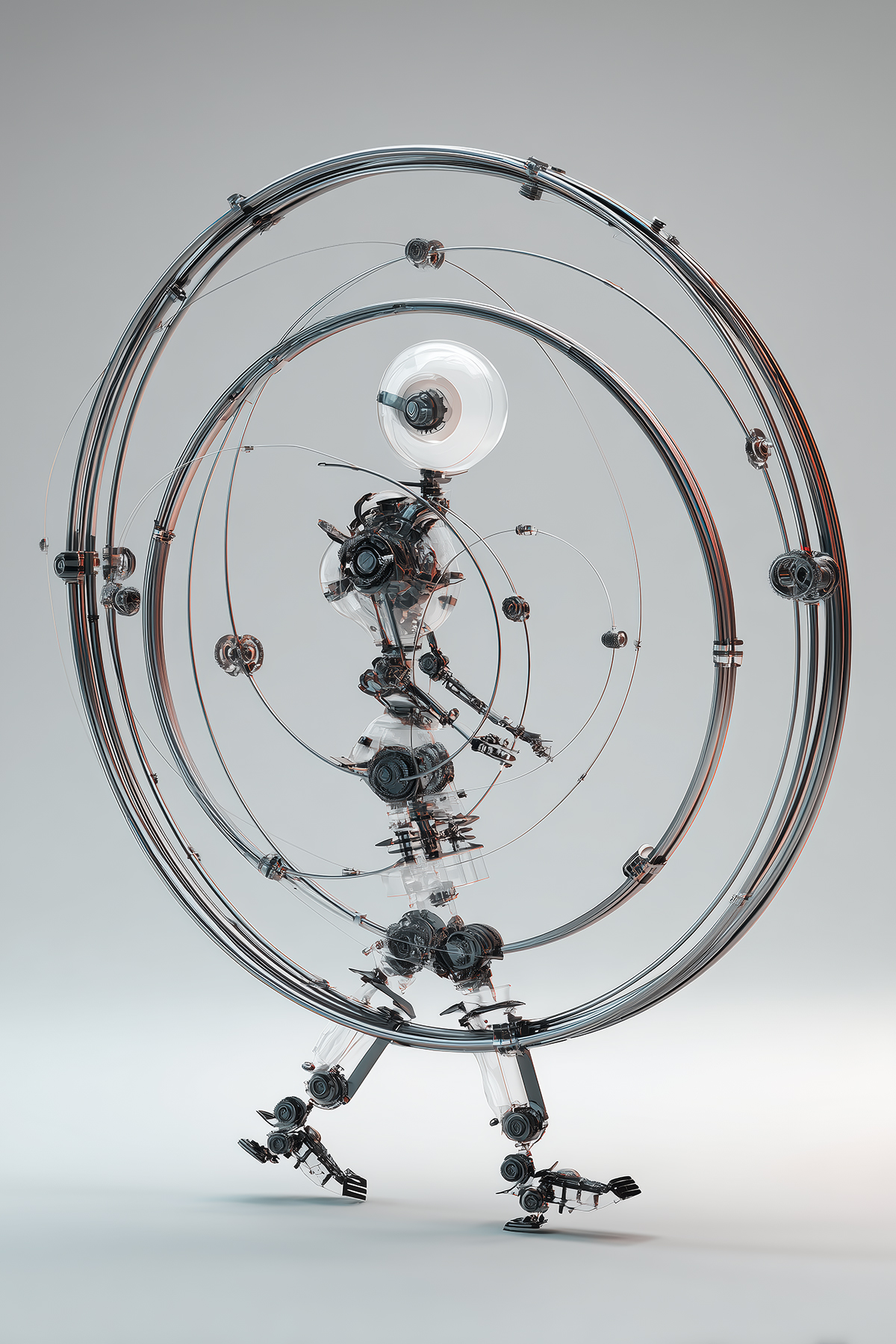

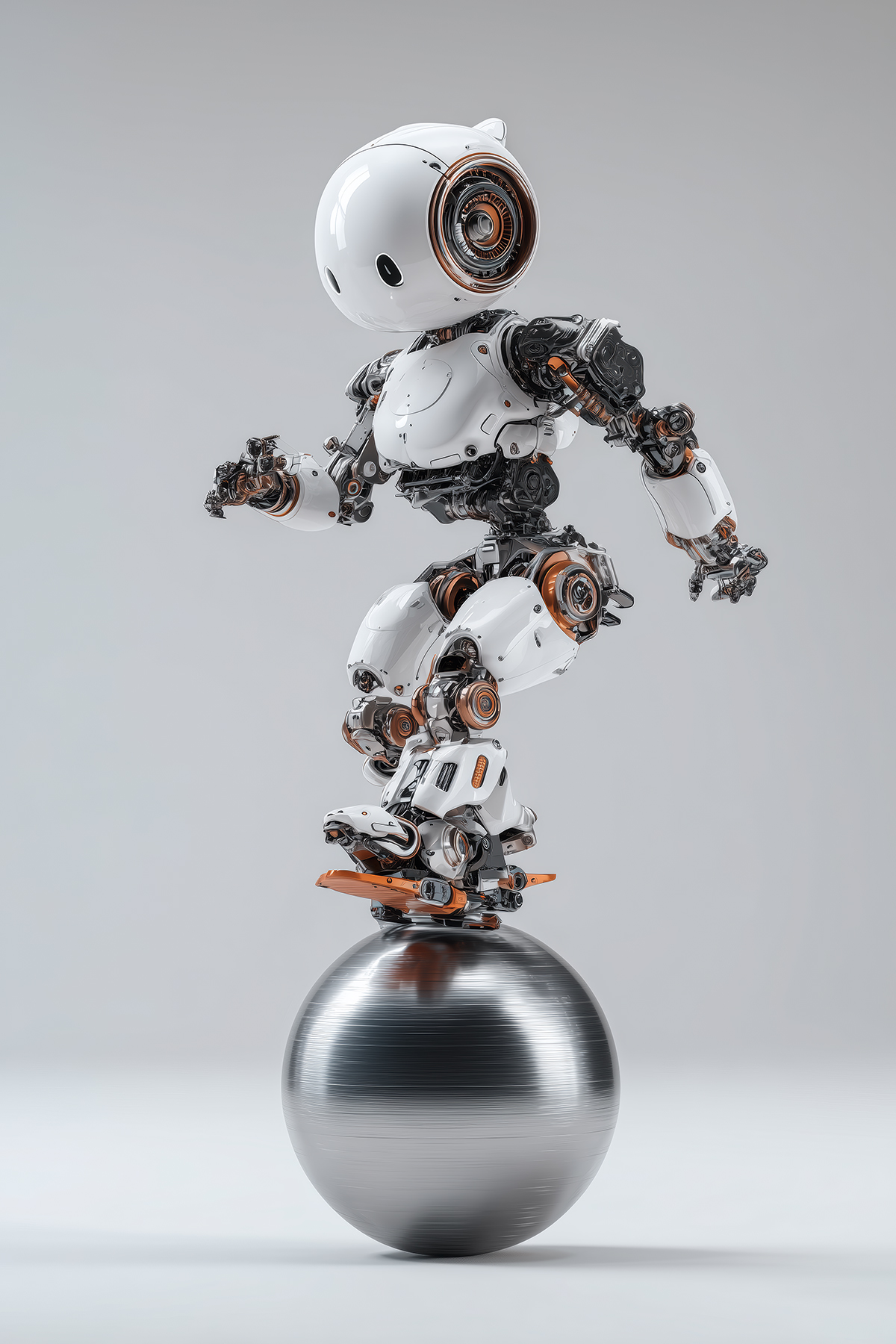
Louis Bec’s Sulfanogrades and Andreas Müller-Pohle’s Robots
Meta-Acervos and New Interpretations Emerging from Error
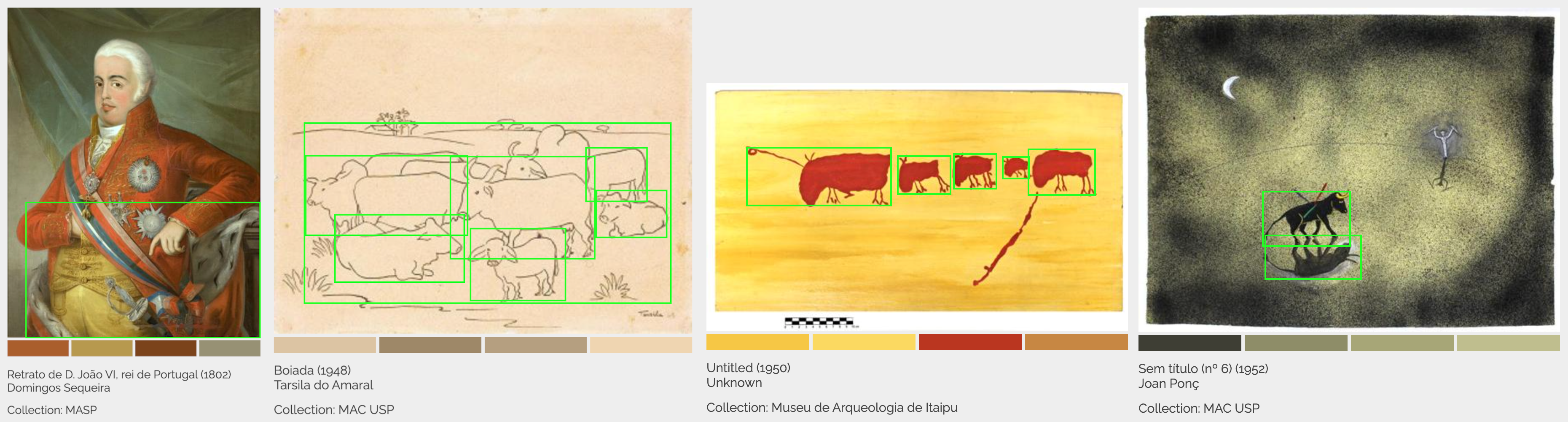
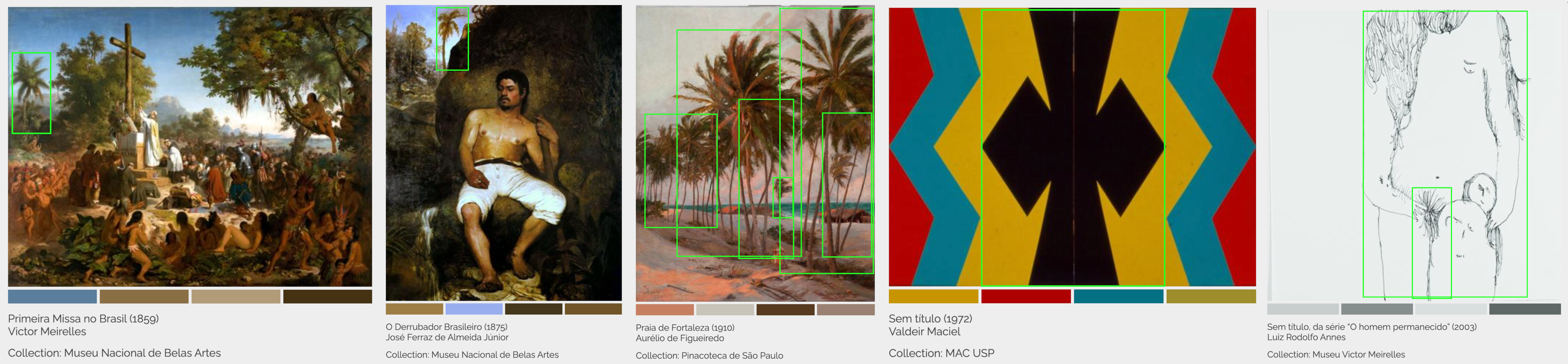
This visual essay examines the application of image classification and object detection algorithms to collections of drawings and paintings from Brazilian museums using Meta-Acervos, a platform that employs artificial intelligence models to analyze, organize and visualize artworks according to institutional, technical, chronological and visual descriptors. Rather than emphasizing the system’s accuracy, the essay focuses on its errors and on the potential for new readings afforded by ambiguity and interpretations not predicted by the program. We argue that this act of playing with errors and information not predicted within the logic of artificial intelligence models points to broader questions of agency and human intention in a world increasingly structured by apparatuses.
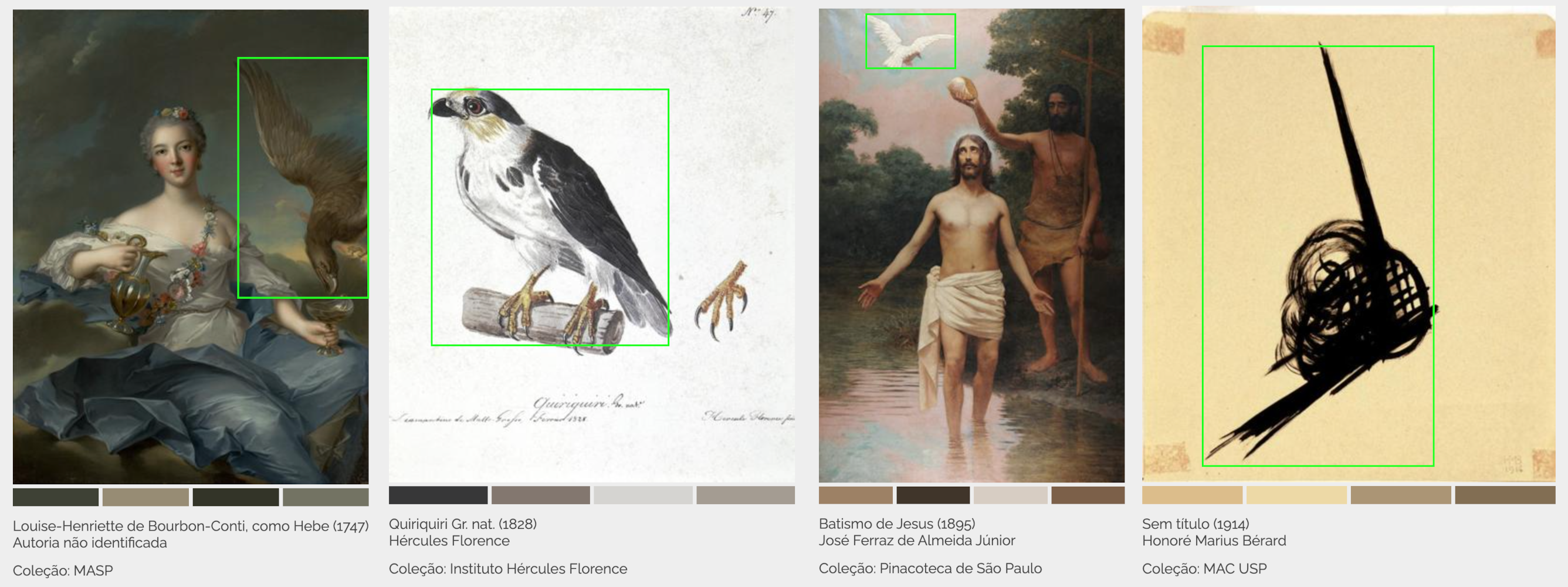
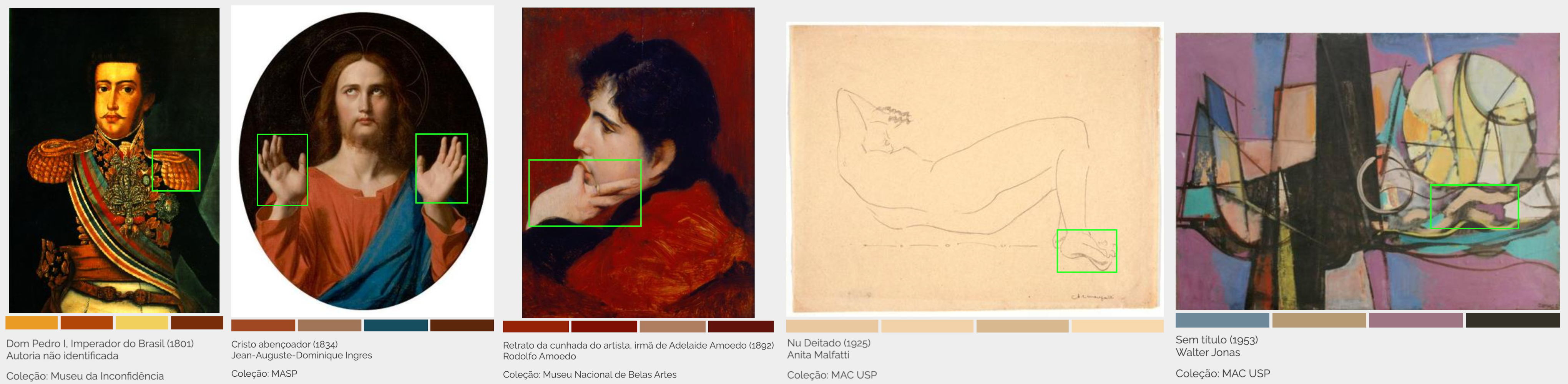
Versuchsreihe zur Auslotung ästhetischer Möglichkeiten K.I.-generierender Mittel in bildgebenden Verfahren anhand von „Rotkäppchen“
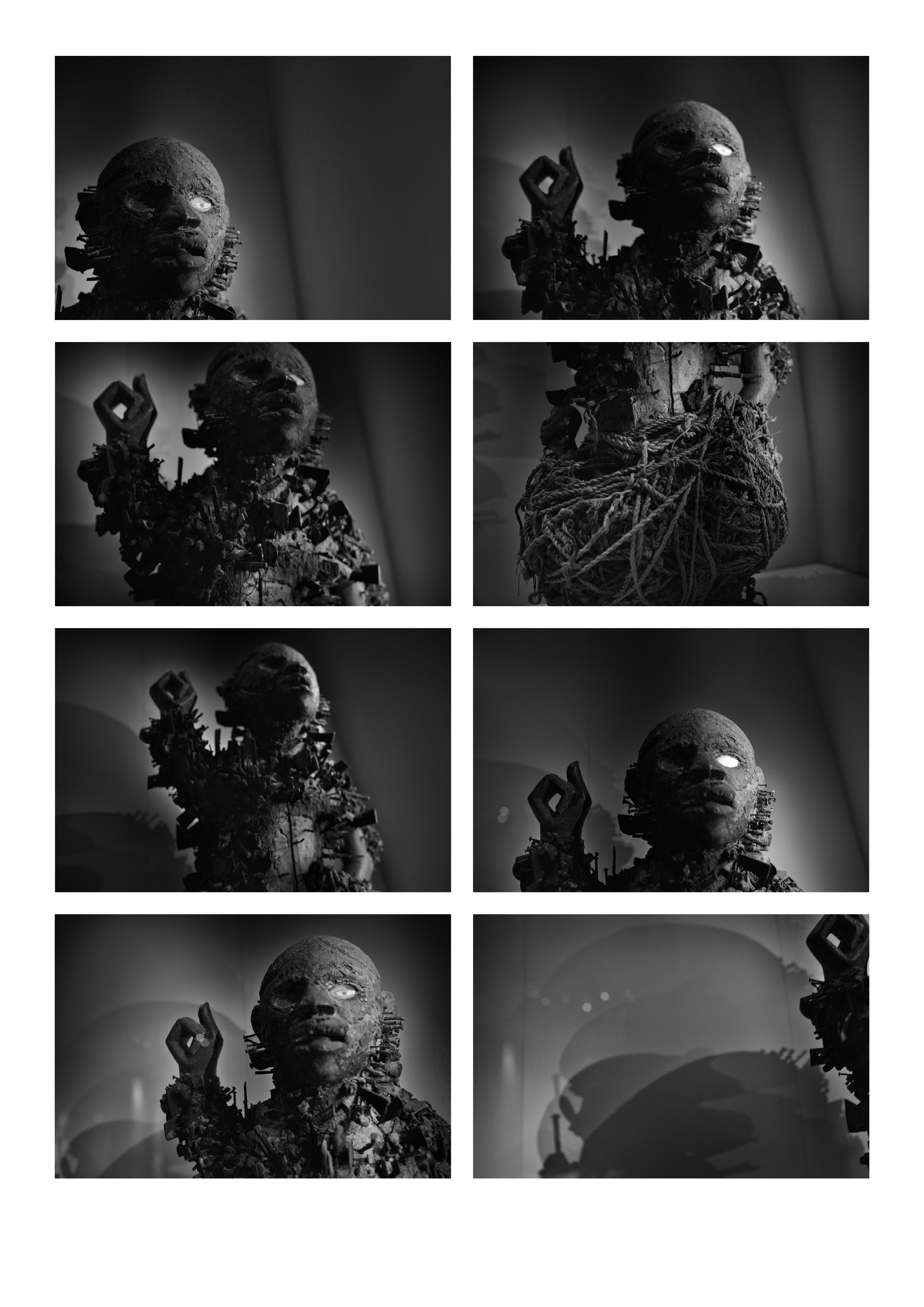
As early as the 1980s, Vilém Flusser described the transition from writing culture to image culture, in which technological images displace texts. This prediction is coming true today, as images disguised as data packets are decisively shaping our actions. They increasingly originate from AI-based image generators that translate language into synthetic images in highly complex, latent spaces, thus re-ordering the relationship between text and image. The artistic experiment titled Rotkäppchen (Little Red Riding Hood) was created by “feeding” AI with original prose sequences of the Grimm Brothers and editing the resulting sequences into a film. The project sheds light on the machine-based translation of language into pictures, and understands itself as critically distanced “art about AI” that, in the sense of Flusser, addresses the functioning and power logics of the apparatuses.



Part III: Language and Linearity
In Dialog With the Black Box: Poetic Resistance to AI’s Algorithmic Homogenization Through Translation
Artificial Intelligence (AI) is here to stay. Some scholars believe that it is a speculative bubble that will soon burst, but the consequences of this period will remain. This paper analyzes this phenomenon through the lenses of Vilém Flusser’s work, in the search for a better understanding of these consequences in our processes of signifying and experiencing the world. Framing AI algorithms as agents of technological contamination over human semiosis, we analyse how the Machine Learning (ML) technique reduce linguistic and perceptual reality to vector embeddings in latent space, enacting a violent abstraction that flattens experience and accelerates cognitive overload. The chain of mathematical and statistical operations needed to train and operate ML algorithms echoes Flusser's reflections on how language and translations work, enabling us to create a dialectical bridge between both visions of the critique of technology. Once the bridge is built, the essay traces parallels between Flusser's theory of translation as ontological impossibility across linguistic cosmoses and algorithmic "similarity" mappings (embeddings) in multimodal generation, highlighting standardization and an impoverished experience, as anticipated by Franco Berardi and Arlindo Machado. Examining AI slop, model collapse, and programmed totalitarianism, we aim to build a reflection about the exclusion of human agency in signification processes of reality, where apparatuses predetermine responses and functionaries become excluded. In this context, Flusser’s practice of translation—where meaning jumps from one cosmos to the other, forcing the intellect to surpass the boundaries of language—is considered an act of creation. The essay brings elements of Flusser’s attention to the aesthetical experience of this practice, which puts it in constant friction with the apparatus of Language to resist uncritical automation. This practice shows us a pragmatic but propositive methodology of counterattacking from inside the apparatus against machinic stereotyping to reclaim dialogical semiosis from computational domination through aesthetic experience.
Quand les machines créent : musique générative et obsolescence du sujet créatif à l’exemple d’Andrew Frelon
This article examines the emergence of fully artificial musical groups, exemplified by the project of Andrew Frelon (The Velvet Sundown), through the philosophical lens of Vilém Flusser’s media theory. While Flusser’s work is often interpreted as visually oriented, this study highlights his conception of music as a non-representational structure of thought and a model for understanding technical apparatuses. The analysis traces the historical shift from computer-assisted music, where technology extended human gesture (as seen in Kraftwerk), to generative music created by artificial intelligence, where the human subject is increasingly displaced. Frelon’s work is presented not merely as a technological hoax but as a form of sociological art that exposes the mechanisms of the information society. By utilizing AI to generate identities, discographies, and synthetic audiences, Frelon demonstrates how cultural narratives can be industrialized. Drawing on Flusser’s concepts of the "alphabetical society", "programmed imagination", and the "functionary of apparatuses", the paper argues that generative music accelerates the transition from a material culture to a world of "non-things". In this new paradigm, music ceases to be an embodied, intersubjective event and becomes a circulating flow of data optimized for private consumption. Consequently, the traditional concert space and the possibility of genuine dialogue are threatened by a closed loop of algorithmic production and bot-driven reception. Ultimately, this study posits that AI-generated music reveals a critical anthropological crisis: the risk of the creative subject becoming redundant in a system where machines converse only with other machines, reducing human agency to the mere management of pre-existing models.
Thus Spoke a Strange Computer / Paths – Programmes – Permissiveness
This contribution forms part of a larger work exploring the telematic culture in which we now live. It is both essay and programme (a complex system of inherent virtualities that will inevitably be realised via components of chance). It is concerned with freedom and the human spirit (matter and mind as energy in flux). It is a meditation on the unique form of thinking we call writing. Its ideas are both explicitly and implicitly communicated (though it is undoubtedly imperfect and at times contradictory). And in the interests of freedom and beauty, I shall say no more about it…
Zögernde Intelligenz –Zeit im humanoiden und artifiziellen Schreiben
When the Chat GPT 3 model developed by Open AI was released to the public on November 28, 2022, a new era began in the development of artificial intelligence, which has been ongoing for over 75 years. While international experts and curious amateurs began to take a keen interest in the workings and results of AI instances, school and university students seized the opportunity in the first few weeks to produce unpopular text assignments with the help of Chat GPT (Tagesschau (2023 a, b, c). Even though prominent errors were still apparent at first, it quickly became clear that AI instances would soon be able to produce reasonably comprehensible texts on any topic. This is especially true for texts that attempt to persuade, such as marketing texts, job applications, concepts, and exposés, but also for the sprawling field of boring and rarely read administrative texts such as accountability reports, dossiers, applications, and minutes. Three years later, these artificial text productions have become even more convincing. They are being implemented silently in many applications and often used unnoticed. They now pose an unresolved problem for school and academic writing, and they have long since found their way into the scientific journalism of respected peer-reviewed journals and academic theses. In the following, I would like to discuss what this development means for the future of writing, referring to Flusser's book Die Schrift. Hat schreiben Zukunft? (1987). I am expressly not concerned here with comparing the quality of the differently generated texts, evaluating the possible intelligibility of machines, or the legal problems of copyright infringement and plagiarism. Instead, I would like to focus on the aspect of writing time, which primarily shapes the individual experience of humanoid writing, but will also determine the cultural status of writing in the future. After all, one of the two most important motives for using AI instances to write texts is the hoped-for time savings (cf. Hoffmann and Schmid 2025). The other motive is the hope for inspiration or, to put it more objectively, laziness in thinking.
Experiencing Programmed Magic: AI Image Generation and the Photo-Roman
This research does not aim to define artificial intelligence theoretically, nor does it seek to provide a systematic exposition of Vilém Flusser’s thought. Instead, it begins from the question of how vision has come to define space in architecture and examines, through practice, the conditions under which technical images operate within processes of AI-based image generation. Writing not as a Flusser scholar but as an architect, the author seeks to unsettle the assumptions through which visually centered conceptions of space have been naturalized via perspective, photography, and digital media. Within this context, the text takes the form of a working report that documents the experience of what Flusser described as the “programmed magic” of technical images as it emerged during the production of an eleven-minute photo-roman. The case study, a photo-roman titled Eyes of Epoché, is a fictional project inspired by philosophical thought experiments concerning perception and knowledge. By depicting a subject who has perceived the world exclusively through vision and remains unable to intuitively comprehend spatial relationships even after regaining bodily movement, the work exposes vision not as a natural or universal faculty but as a system constructed through specific conditions and forms of learning. The production process, which moved from collage-based storyboards to AI-generated images, reveals a gradual shift in authorship from the act of designing images toward the adjustment and selection of possibilities provided by a generative program. This research approaches AI-based image generation as a form of technical imagery continuous with photography, arguing that their primary difference lies not in representational outcomes but in the speed and manner through which uncertainty and failure are resolved. In doing so, it raises the question of whether the possibility of artistic play, as articulated by Flusser, can still be established in relation to this emerging apparatus.
Part IV: Neg-Anthropology
Künstliche Intelligenz(en) denken mit Vilém Flusser / Rethinking Artificial Intelligence(s) with Vilém Flusser
In 2024, my article “Artistic Intelligence versus Artificial Intelligence” on the relationship between creativity and artificial intelligence has been published in the Art Nodes issue no. 34 on Materiology and Variantology: invitation to dialogue – already with references to Vilém Flusser. In the following article, I will supplement the considerations presented there with topics related to AI in relation to work, education, culture, and humanity. The topics of AI and creativity, AI and culture, and AI and work point to a problematic current state of affairs, while the topics of AI and education and AI and humanity can be read as recommendations for dealing with AI in the future. Among others, Flusser's essays “Hochschulen“ (Universities), “Ästhetische Erziehung“ (Aesthetic Education), and “Rückschlag des Werkzeugs auf das Bewusstsein“ (The Backlash of the Tool on Consciousness) are cited.
Cybernetic Memories: Flusser’s Apparatus in the Age of Artificial Intelligence
This essay revisits Vilém Flusser’s concept of cybernetic memories to examine artificial intelligence as a terminal stage of the Apparatus, where predictive archives risk foreclosing the event of memory itself. Through dialogue with Bernard Stiegler, Jacques Derrida, Frédéric Neyrat, and Gilbert Simondon, it distinguishes memory as storage from memory as embodied impression, arguing that forgetting, abstraction, and rupture are conditions of learning and individuation. Against predictive temporality, the essay proposes prophetic survival, dialogical cybernetics, and the mechanologist as figures for preserving mental integrity, techno-intersubjectivity, and the human capacity for deep memory within AI-mediated technical systems.
The Generative AI Factory
This article examines generative artificial intelligence not as a disembodied, cloud based phenomenon, but as a planetary factory. It is a vast and material infrastructure rooted in geological extraction, logistical networks, and asymmetrical labor relations. Drawing on Vilém Flusser's premise that to decipher an era one must decode its factories, the analysis traces the production chain of contemporary AI across multiple sites. These include rare earth mining, semiconductor manufacturing, data centers, submarine cables, surveillance systems, and space colonization. The text also presents the art pieces of Trevor Paglen and Elisa Giardina Papa to shed light on two crucial matters: how humans are being trained by AI systems, and what invisible infrastructures support the entire edifice. Beneath what appears as immediate and seamless mediation lies a complex metabolic process of ingestion, digestion, excretion, and re-ingestion of data. This is a logic that Kate Crawford terms the "metabolic image." The article concludes that the AI factory is not an inescapable fate. Rather, it is the crystallization of specific political and economic choices. Demystifying its material and operational logic is a necessary condition for reclaiming human agency, imagining alternative futures, and reopening the apertures that, in Flusser's warning, are rapidly closing off.
Über den menschlichen Kopf als archivische Form
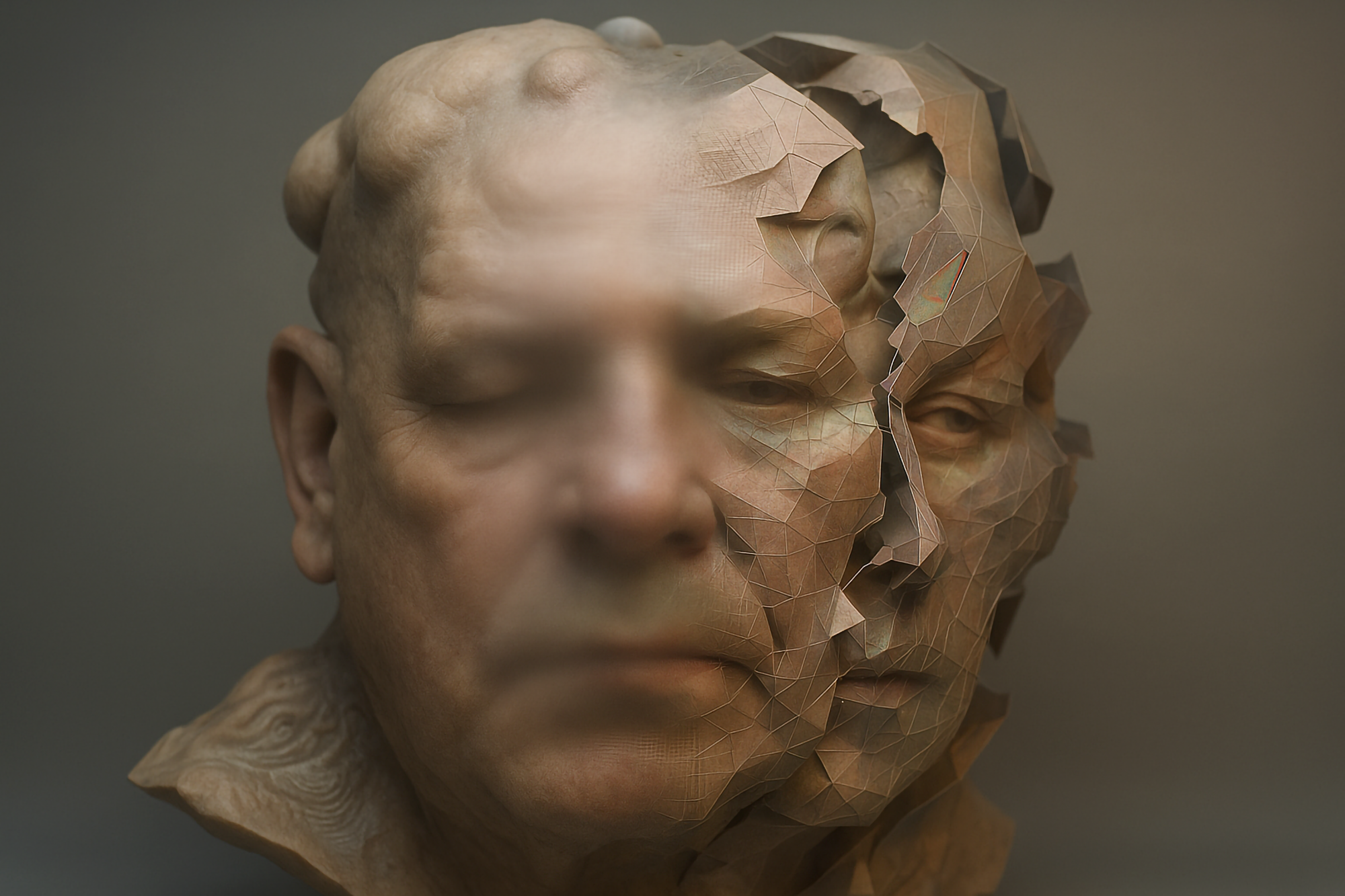
The series examines the human head as an archival structure operating at the threshold between representation and material register. Although the images maintain the frontal conventions of portraiture, they suspend its expressive and identificatory functions. The head is treated as a site of accumulation: organic matter, time, and algorithmic processes converge on its surface without hierarchy or narrative orientation. The eyes remain closed, gestures are neutralized, and variation is minimized. Created through a controlled interaction of digital modeling, image synthesis, and procedural iteration, the works operate as a closed system in which difference emerges slowly and cumulatively. Rather than asserting individuality, the series constructs a state of persistence in which the body appears as a storage medium subject to compression, erosion, and long-term transformation.


Introductory Notes on Marcelo Mercado’s Über den menschlichen Kopf
Flusser et l'IA générative
This article is about how the emergence of generative IA, shaping both text and image, can be seen through the eye of Vilém Flusser. This article follows mainly the essay « Towards a Philosophy of Photography ». It questions how images are made by these algorithms and what their purpose is. The article goes through what is generative AI, the ambiguity of the black box models, how designers work with them. It focuses also on real model information to corroborate within what’s told in the article.
Climbing out of the Abyss: On Tearing Objects, Injecting Values, and Automating Work
This essay is an expanded discussion following Vilém Flusser’s unpublished essay On Being Subject to Objects in which he argued that the human is split between what is and what should be, living in the abyss between phenomena and values. By turning branches into sticks and rare minerals into data centers, the human makes a vain attempt to produce things to climb out of its abyss while increasingly becoming subject to its own cultural objects. Following a media materialist approach, the essay highlights the material dependencies of seemingly immaterial systems like artificial intelligence. The more elaborate our cultural objects become, the harder it is to trace them back to the geological conditions that made them possible, while their reliance on what the Earth can provide only deepens. Flusser identified two phases of cultural production: the first, choosing values and imagining what phenomena should become, and the second, the physical work of forcing phenomena into those values, turning them into cultural objects. His optimistic approach to automation suggested that if machines could take over the second phase, humans might finally attend to the first. Today, automation is far from what Flusser believed it would be. Rather than separating value-oriented thinking from mechanical execution, automation has made the second phase less visible but more pervasive, distributed across underpaid labor, energy grids, and extraction sites, deepening our entanglement with natural resources and pushing us further into the abyss we desperately try to climb out of.
Most-historical Apparatus : “AI” and the Crisis of Linearity
This paper analyzes machine learning-based services such as LLMs and AI-image generation through Vilém Flusser's account of linearity, causality, and rationality as historically specific cultural techniques. It argues that these technological applications do not suspend linear thinking but operationalize it at scale through ramified, sequential procedures that remain strictly causal. The apparent non-linearity of probabilistic generation of media artifacts such as text, image and video belongs to the level of experience, not to the functioning of the apparatus. Rationality persists within these technological media as program. The contemporary crisis of rationality is therefore not its disappearance but its withdrawal from conscious critique into automated systems controlled by institutional power. The paper argues that the foundational democratic intuitions which emerged with the development of linear writing and linear rationality have been historically constrained by extra-rational exercise of power. Only through the radical democratisation of that power can the emancipatory potential promised of hyper-rational so-called “AI" be realized.