Baruch Gottlieb
UdK Berlin IZM, Institut für Zeit-basierte Medien
Baruch Gottlieb is an artist, writer, curator, and educator based in Berlin. Trained as a filmmaker, he holds a doctorate in digital aesthetics from the University of Arts Berlin, where he teaches as well as at the University of Applied Sciences Potsdam. He is founder with Steffi Winkler of Flusser.club, an association dedicated to the work of Vilém Flusser, and with Ji Yoon Yang of Feminist Art School. He also works as curator at West Den Haag where he has presented exhibitions and projects dedicated to the work of Flusser, McLuhan Haraway and Spinoza. His books include A Political Economy of the Smallest Things (2016), and Digital Materialism (2018) and Most-Human Condition (2024). His practice spans electronic media art, exhibition-making, and critical writing on digital culture and political economy.
Articles of Baruch Gottlieb
Most-historical Apparatus : “AI” and the Crisis of Linearity
This paper analyzes machine learning-based services such as LLMs and AI-image generation through Vilém Flusser's account of linearity, causality, and rationality as historically specific cultural techniques. It argues that these technological applications do not suspend linear thinking but operationalize it at scale through ramified, sequential procedures that remain strictly causal. The apparent non-linearity of probabilistic generation of media artifacts such as text, image and video belongs to the level of experience, not to the functioning of the apparatus. Rationality persists within these technological media as program. The contemporary crisis of rationality is therefore not its disappearance but its withdrawal from conscious critique into automated systems controlled by institutional power. The paper argues that the foundational democratic intuitions which emerged with the development of linear writing and linear rationality have been historically constrained by extra-rational exercise of power. Only through the radical democratisation of that power can the emancipatory potential promised of hyper-rational so-called “AI" be realized.
Introductory Notes on Marcelo Mercado’s Über den menschlichen Kopf
Louis Bec’s Sulfanogrades and Andreas Müller-Pohle’s Robots
To Save Philosophy in a Universe of Technical Images
Philosophy, origin and apotheosis of the Humanist project, seems to have been surpassed in a world of extreme and ubiquitous automated processes. Automation threatens to truly “taken control”, and subordinate all human activity to the functions inscribed in the machine. The kaleidoscopticon of contemporary culture seems to indicate a return to pre-literate “magical thinking” but it is in fact a product of highly literate scientific, technical literacy. Flusser urges us to encounter the persistent importance of causal, textual thinking at work inside every apparatus to help steer the transformations, which are taking place in ourselves and in our world. Flusser makes this plea alongside a contention that linear, causal, conventional textual practices are no longer adequate to convey our ideas and experience highly in-formed by the new technologies. He exhorts us to use “technical images”. It becomes evident that Flusser’s project is to save philosophy, or restate the importance of philosophical practices, in an age where literacy has gone sub rosa. Using examples from Flusser’s experimental collaborations with artists Louis Bec and Fred Forest, this short essay will attempt to elaborate what Flusser means with philosophical practice, which uses technical images.
From Abstraction to Concretion: A Brief Overview of the Exhibition Project “BODENLOS_Vilém Flusser and the Arts”
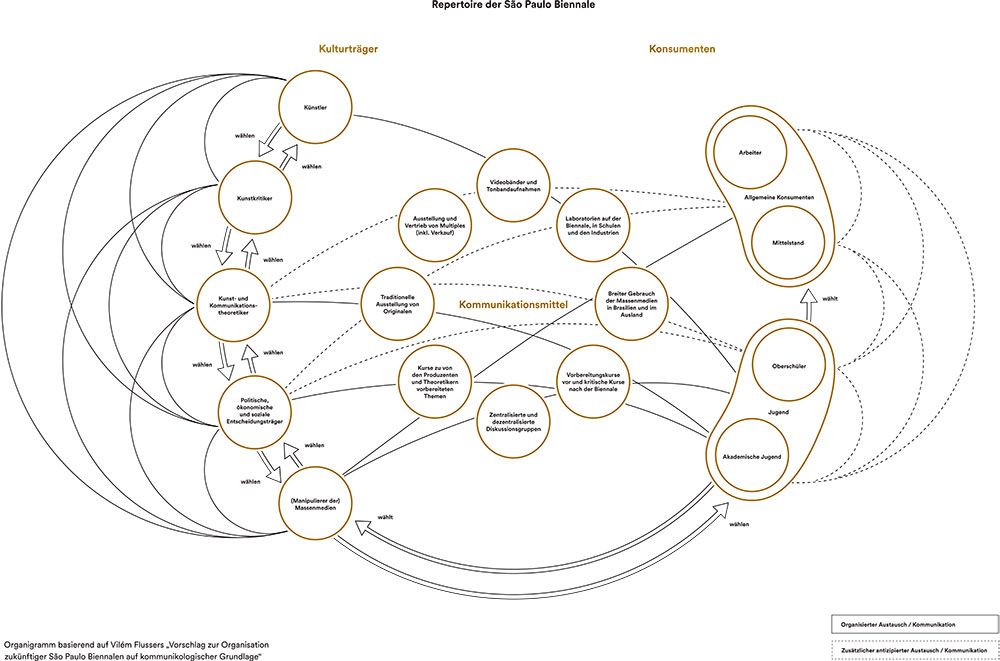
We have attempted a mise-en-scène of Flusser’s thinking in museum settings, applying the techniques of exhibition-making to produce a space to encounter Flusser anew in all his multifarious and passionate contradictions. Flusser emerges here as an irrepressible social actor with proto-curatorial, perhaps even meta-artistic agendas.
Translations and Transcriptions from Bielicky’s Recordings with Flusser in Summer 1991
In August 1991, Michael Bielicky brought his video camera with him to spend a few days in Robion with Vilém Flusser and Edith Flusser. The resulting intimate video recordings would be among the last made with Flusser before he died. Beside formal interviews, Bielicky filmed Flusser giving an anthropological sightseeing tour of the area around his home, in addition to a somewhat awkward visit from some television producers. Though Bielicky’s trip was supported by the German television channel WDR, only one part of the video recordings was ever shown on television—the scenes in which Flusser speaks from a window of his house about the prospects for Europe after the fall of the Soviet Union. The rest of the footage was edited into “Vilém Flussers Fluss” (Vilém Flusser’s Flow) released on video by 235 Media Verlag Köln.